Lds Fair Being Born Again Means
You are here

February 7, 2019
KnoWhy #501
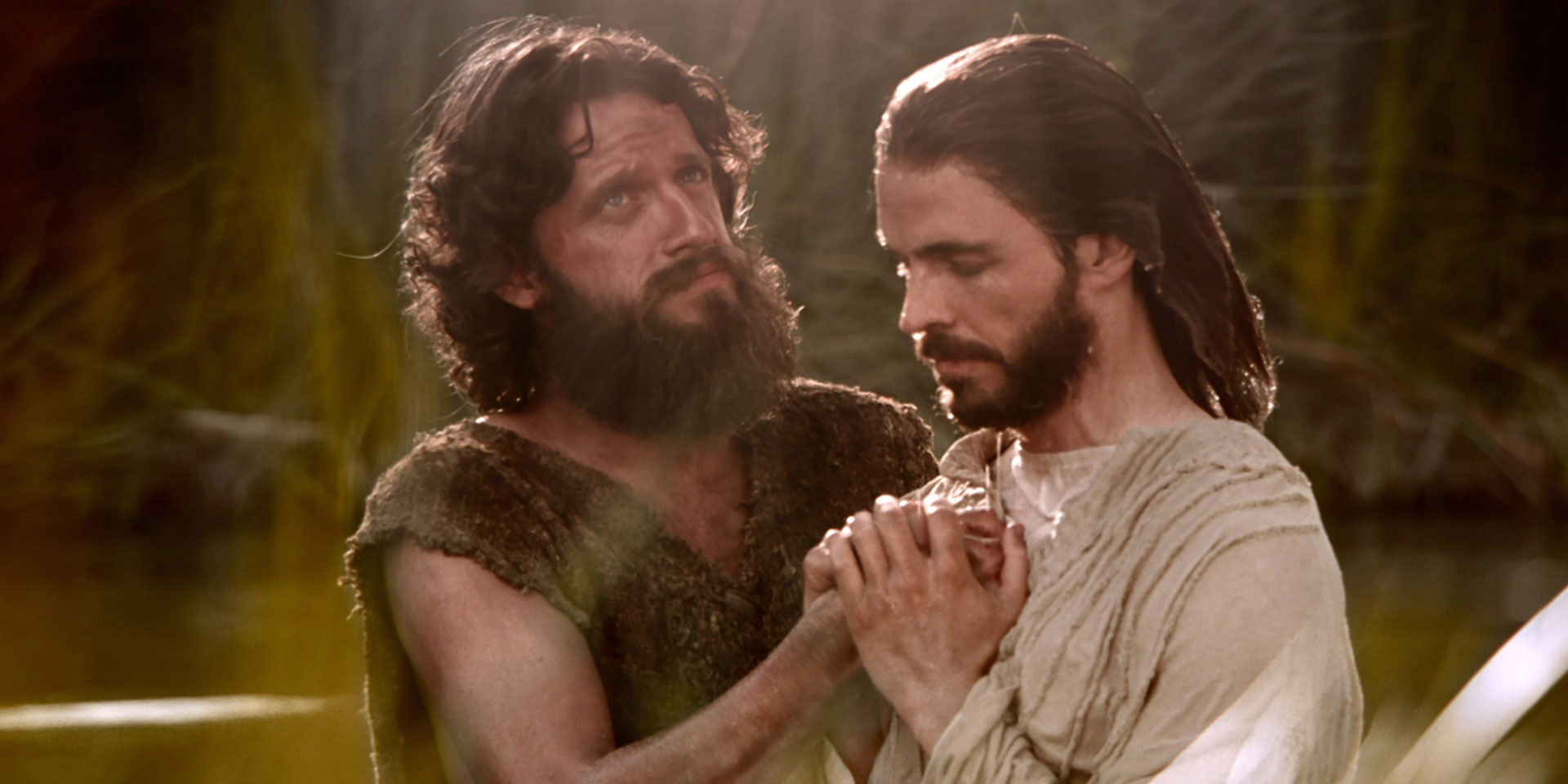
Still Image from "The Baptism of Jesus" via LDS Media Library
"And the Lord said unto me: Curiosity not that all mankind, yea, men and women, all nations, kindreds, tongues and people, must be born once more; yea, born of God, changed from their lecherous and fallen state, to a state of righteousness, being redeemed of God, becoming his sons and daughters."
Mosiah 27:25
The Know
The need for Christ's followers to be "born again," every bit famously described in John three:3, is one of the most well-known New Testament doctrines.ane It captures mankind's universal demand for spiritual transformation and offers hope that such transformation tin come up to all who seek it. Yet this doctrine has likewise go a matter of debate and controversy among some Christian believers. Thankfully, the Book of Mormon discusses existence "built-in once again" or "born of God" on a number of occasions. These relevant passages, when correlated with other scriptures and Latter-day revelations, offer vividly engaging examples and spiritually impressive explanations that analyze and deepen whatever reader's understanding of what it means to be "born over again."ii
One fascinating example comes from the story of Alma the Younger. Afterward being rebuked by an angel, Alma vicious into a weak and helpless condition where he could no longer speak and his limbs lost their forcefulness. When Alma awoke from this state, he declared,
I have repented of my sins, and have been redeemed of the Lord; behold I am born of the Spirit. And the Lord said unto me: Marvel not that all mankind, yea, men and women, all nations, kindreds, tongues and people, must be born over again; yea, built-in of God, changed from their carnal and fallen state, to a country of righteousness, beingness redeemed of God, becoming his sons and daughters; And thus they go new creatures; and unless they exercise this, they can in nowise inherit the kingdom of God. (Mosiah 27:24–26)3
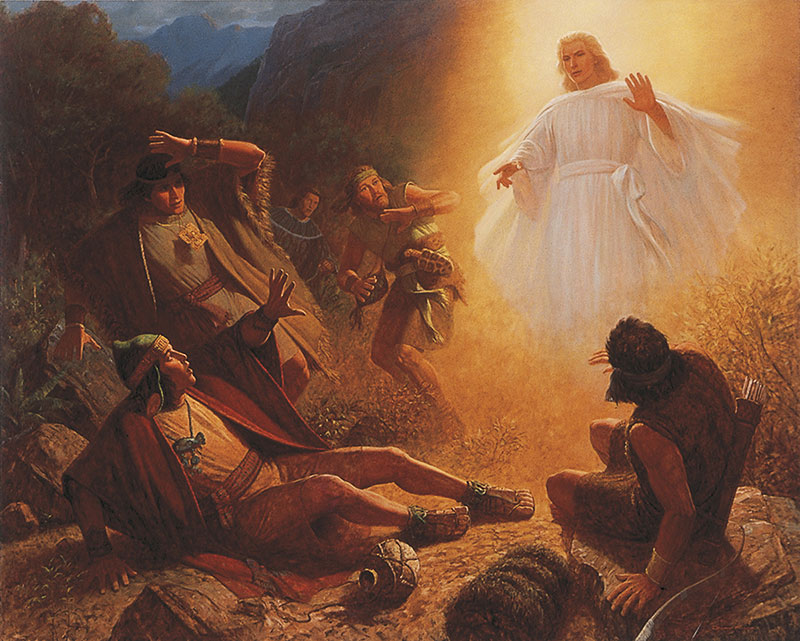
Conversion of Alma the Younger past Gary L. Kapp. Image via LDS Media Library.
Alma'due south language hearkens dorsum to Rex Benjamin's famous speech where he alleged to his people,
And now, because of the covenant which ye have made ye shall be called the children of Christ, his sons, and his daughters; for behold, this day he hath spiritually begotten yous; for ye say that your hearts are inverse through organized religion on his proper name; therefore, ye are born of him and have become his sons and his daughters. … I would that ye should accept upon you the name of Christ, all you that have entered into the covenant with God that ye should be obedient unto the end of your lives. (Mosiah 5:7–8)4
Finally, when Alma was preaching to the people of Zarahemla, he asked them a number pointed questions apropos spiritual rebirth. Alma'due south own harrowing experience with existence spiritually reborn makes these questions specially insightful:
And now behold, I ask of you lot, my brethren of the church building, have ye spiritually been born of God? Have ye received his paradigm in your countenances? Have ye experienced this mighty change in your hearts? Practise ye do faith in the redemption of him who created you? … I say unto you, tin ye look up to God at that day with a pure middle and make clean easily? (Alma v:14–15, 19)5
Among the many important points that tin be taken from these Book of Mormon passages are the following:
- Being built-in again is universally required of all of God's children (Mosiah 27:25; cf. Alma 5:49).
- Existence built-in once again is needed to inherit the Kingdom of God (Mosiah 27:26; cf. Alma 5:51).
- Existence born again signifies "faith in the redemption of him who created you" (Alma 5:fifteen).
- Beingness born again signifies that sincere repentance has taken place (Mosiah 27:24; cf. Alma v:49–51).
- Those who are built-in again enter into a covenant with God to "be obedient unto the end of [their] lives" (Mosiah v:8).
- Those who are built-in once again accept upon themselves the "name of Christ" (Mosiah 5:8).
- Those who are born again become the "children of Christ, his sons, and his daughters," and are "spiritually begotten" of Him (Mosiah 5:vii).6
- The hearts of those who are born over again are "changed through organized religion on [Christ's] proper noun" (Mosiah five:7; Alma 5:12–14).
- Those who are born again receive Christ'south "image in [their] countenances" (Alma v:14).seven
- Those who are born again have "a pure heart and clean hands" (Alma v:nineteen).
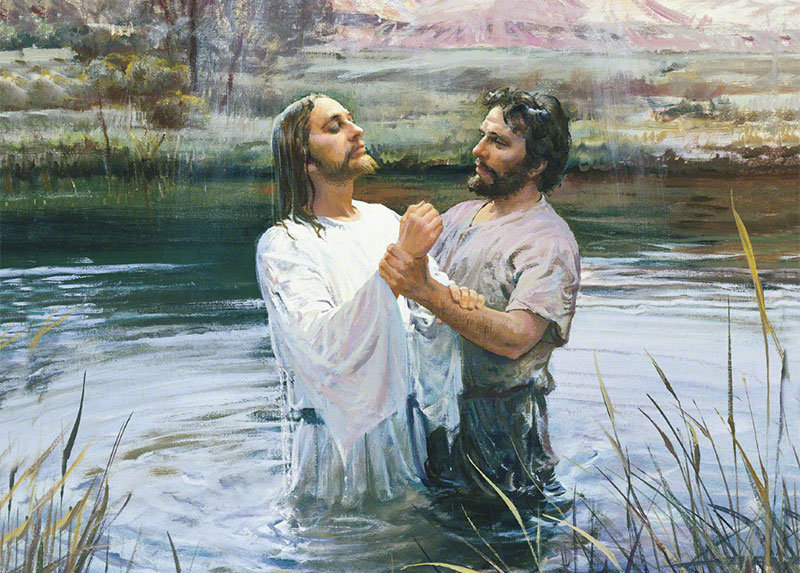
John Baptizing Jesus by Harry Anderson. Epitome via LDS Media Library.
The Why
While the above passages don't stand for all that the Book of Mormon has to say about existence born again, they give a good representation of its teachings on the subject. What should be clear is that, rather than being a singular event or occurrence, being born again is a process of spiritual rebirth and refinement.8 It begins with a sacred covenant or delivery to change our lives, which is formally entered into at baptism,nine and then it requires lasting organized religion, repentance, and spiritual purity on our part—in both deportment and intent.x In order to facilitate the procedure of spiritual refinement, the souvenir of the Holy Ghost is conferred (past the laying on of hands) upon all those who are baptized (see Moroni 2; 3 Nephi xix:20–22).
In response to our sincere and persistent efforts to exercise faith and repent, our hearts will be spiritually transformed through the power of Christ and so that "we have no more disposition to exercise evil, but to exercise good continually" (Mosiah 5:2). As S. Michael Wilcox has noted, "Whenever the Volume of Mormon speaks of being born again, the heart is the center of the altered state."eleven This internal transformation then acts as a forerunner to a more eternal and permanent external transformation of our physical bodies, which will be facilitated through the power of Christ's resurrection.12
This dual procedure of transformation, first spiritual and then physical,13 is aptly represented by the ordinance of baptism, which in various ways symbolizes birth, death, and resurrection.14 While baptism is indeed an consequence, the process of spiritual rebirth which it symbolically initiates is a lifelong effort.fifteen Although individuals may sometimes feel dramatic and rapid spiritual transformations, like the Campaigner Paul and Alma the Younger did, they notwithstanding must "exist obedient unto the finish of [their] lives" (Mosiah v:eight). Otherwise, the positive spiritual transformation which they experienced will be reversed. As Mormon warned, they will "become more hardened, and thus their state becomes worse than though they had never known [or experienced] these things" (Alma 24:30).16

Male child Being Baptized via LDS Media Library.
With these principles in mind, readers may wonder where they stand personally in this procedure of spiritual rebirth. Elder Bruce R. McConkie taught that the answer can exist plant in the Volume of Mormon:
Read the fifth chapter of Alma for the recitation of the tests that tell a person whether he has been built-in over again and how he knows. You know if you have been born once more, or y'all know the degree to which you have been born again; it is the measure to which y'all proceed the commandments and feed the Lord's sheep and strengthen your brethren. In other words, it is the measure of your involvement in the things of the Spirit, in the things of the Church building.17
While what we do outwardly is certainly important, the Volume of Mormon demonstrates that what we get inwardly is of even greater significance.18 Eventually, equally we truly come unto Christ, the inward transformation that we and so desire volition be permanently "engraven" upon united states of america (Alma v:19). We will "become new creatures" in Christ (Mosiah 27:26), who will "seal [u.s.a.] his" through the infinite power of His Atonement and resurrection (Mosiah 5:fifteen). Better than any other book of scripture, the Volume of Mormon outlines this process of deep spiritual transformation, providing readers a clear path toward eternal life.
This KnoWhy was made possible by the generous support of The Welch Family Trust.
Further Reading
D. Todd Christofferson, "Born Once again," Ensign, May 2008, online at lds.org.
Jerome M. Perkins, "Alma the Younger: A Disciple'due south Quest to Become," in Living the Book of Mormon: Constant by Its Precepts, ed. Gaye Strathearn and Charles Swift (Provo, UT: Religious Studies Center, Brigham Young Academy, 2007), 151–162.
Brent L. Top, "Spiritual Rebirth: Have Ye Been Born of God?" in The Book of Mormon and the Message of The Four Gospels, ed. Ray L. Huntington and Terry B. Ball (Provo, UT: Religious Studies Eye, Brigham Young University, 2001), 201–217.
James Eastward. Faust, "Born Over again," Ensign, May 2001, online at lds.org.
S. Michael Wilcox, "Spiritual Rebirth," in Mosiah, Conservancy Only Through Christ, Book of Mormon Symposium Serial, Book v, ed. Monte South. Nyman and Charles D. Tate, Jr. (Provo, UT: Religious Studies Center, Brigham Immature University, 1991), 247–260.
- 1. For other New Testament references to being "born once again" or "born of God," encounter 1 Peter 1:23; 1 John three:ix–10; ane John 4:7; one John v:1, iv.
- 2. For a general treatment of this topic, see Ed J. Pinegar, "Born of God," Encyclopedia of Mormonism, ed. Daniel H. Ludlow (New York, NY: Macmillan, 1992), ane:218–219.
- iii. For further analysis of Alma's conversion, see Book of Mormon Cardinal, "Why Was Alma Converted? (Alma 36:21)," KnoWhy 144 (July 15, 2016); S. Kent Chocolate-brown, "Alma's Conversion: Reminiscences in His Sermons," in Alma, The Testimony of the Word, Book of Mormon Symposium Series, Volume 6, ed. Monte S. Nyman and Charles D. Tate Jr. (Provo, UT: Religious Studies Center, Brigham Young Academy, 1992), 141–156; reprinted in S. Kent Brown,From Jerusalem to Zarahemla: Literary and Historical Studies of the Book of Mormon (Provo, UT: Religious Studies Center, Brigham Young Academy, 1998), 113–127; John Westward. Welch, "Three Accounts of Alma'south Conversion," inReexploring the Book of Mormon: A Decade of New Research, ed. John W. Welch (Salt Lake City and Provo, UT: Deseret Book and FARMS, 1992), 150–153; John W. Welch and J. Gregory Welch,Charting the Book of Mormon: Visual Aids for Personal Written report and Teaching (Provo, UT: FARMS, 199), charts 106–107; Jerome Thou. Perkins, "Alma the Younger: A Disciple's Quest to Go," in Living the Volume of Mormon: Constant by Its Precepts, ed. Gaye Strathearn and Charles Swift (Provo, UT: Religious Studies Middle, Brigham Young University, 2007), 151–162.
- 4. Run into Book of Mormon Central, "Why Did Rex Benjamin Say That His People Would be Sons and Daughters at God'southward Right Hand? (Mosiah v:seven)," KnoWhy 307 (May 1, 2017); Matthew L. Bowen, "Becoming Sons and Daughters at God's Right Hand: King Benjamin's Rhetorical Wordplay on His Own Name,"Journal of the Book of Mormon and Other Restoration Scripture 21, no. 2 (2012): 2–13; Robert L. Millet, "The Ministry of the Father and the Son," in The Book of Mormon: The Keystone Scripture, ed. Paul R. Cheesman, S. Kent Brownish, and Charles D. Tate, Jr. (Provo, UT: Religious Studies Center, Brigham Immature Academy, 1988), 57–60.
- 5. Come across Book of Mormon Central, "Why Did Alma Inquire Church Members Fifty Probing Questions? (Alma v:14–15)," KnoWhy 112 (June 1, 2016).
- 6. Conversely, those who remain in their sins and never undergo spiritual rebirth are the "the children of the kingdom of the devil" (Alma 5:25; cf. Mosiah five:10).
- seven. See Book of Mormon Central, "Why Did Alma Ask virtually Having God's Image Engraven upon One's Countenance? (Alma 5:19)," KnoWhy 295 (April 3, 2017).
- viii. For commentary on the diverse Christian misunderstandings of the process of spiritual rebirth, see Robert L. Millet, "Joseph Smith Encounters Calvinism," BYU Studies Quarterly 50, no. iv (2011): 23–24: "When men and women sincerely blast their sins to the cross of Christ, their identity is changed and their nature is transformed. And notwithstanding, as major Christian writers have pointed out recently, too many professing Christians have walked an alley, signed a carte, prayed a prayer, and notwithstanding non forsaken worldliness. They talk the talk only do not walk the walk: they do not live essentially whatsoever differently than people of the world. And why is this? The consensus among many of these recent Christian writers is that so much emphasis has been placed upon salvation equally a free gift, upon the grace of Deity and the alarm against legalistic obedience, that as well little emphasis has been placed upon the discipleship associated with the Savior's invitation: 'If any man will come after me, let him deny himself, and accept up his cross daily, and follow me' (Luke ix:23), or: 'If ye love me, continue my commandments' (John fourteen:15). Salvation has been teased apart from discipleship. Conversion and rebirth have been separated from obedience. An unintended but inappropriate wall has been constructed between justification and sanctification."
- 9. Brent L. Peak has described baptism as the "Gateway to Spiritual Rebirth." Brent L. Pinnacle, "Spiritual Rebirth: Accept Ye Been Born of God?" in The Volume of Mormon and the Bulletin of The 4 Gospels, ed. Ray L. Huntington and Terry B. Brawl (Provo, UT: Religious Studies Center, Brigham Young University, 2001), 202.
- 10. Come across Elder D. Todd Christofferson, "Built-in Again," Ensign, May 2008, online at lds.org: "You may ask, 'Why doesn't this mighty alter happen more quickly with me?' You should think that the remarkable examples of Rex Benjamin'south people, Alma, and some others in scripture are simply that—remarkable and not typical. For most of usa, the changes are more gradual and occur over time. Being built-in again, unlike our physical birth, is more a procedure than an event. And engaging in that process is the central purpose of mortality."
- 11. See South. Michael Wilcox, "Spiritual Rebirth," in Mosiah, Salvation But Through Christ, Book of Mormon Symposium Series, Book v, ed. Monte S. Nyman and Charles D. Tate, Jr. (Provo, UT: Religious Studies Center, Brigham Immature University, 1991), 251.
- 12. Run across 3 Nephi 28:38; Doctrine and Covenants 76:70.
- xiii. In a passage which explains this duality in all of God'southward creations, the Lord declared "as the words have gone forth out of my mouth even and so shall they be fulfilled, that the first shall exist concluding, and that the last shall exist first in all things whatsoever I have created past the word of my power, which is the power of my Spirit" (Doctrine and Covenants 29:xxx).
- 14. See Noel B. Reynolds, "Understanding Christian Baptism through the Book of Mormon," BYU Studies Quarterly 51, no. 2 (2012): iii–37.
- 15. Come across Joseph Fielding McConkie and Robert Fifty. Millet, Doctrinal Commentary on the Book of Mormon, Volume Two: Jacob through Mosiah (Common salt Lake City, UT: Bookcraft, 1988), 174.
- xvi. Encounter likewise, Doctrine and Covenants twenty:32).
- 17. Bruce R. McConkie, "Be Ye Converted," accost given at the BYU Beginning Stake Quarterly Conference (11 February 1968), as cited in Larry East. Dahl, "The Doctrine of Christ: 2 Nephi 31–32," in 2d Nephi, The Doctrinal Construction, Book of Mormon Symposium Series, Volume 3, ed. Monte S. Nyman and Charles D. Tate, Jr. (Provo, UT: Religious Studies Center, Brigham Young University, 1989), 367.
- xviii. For example, Book of Mormon prophets repeatedly recognized that becoming inwardly "live in Christ" held greater value than merely complying with outward performances and ordinances (see 2 Nephi 25:25; cf. Mosiah 13:27–32).
KnoWhy Citation
Related KnoWhys
Subscribe
Get the latest updates on Book of Mormon Cardinal and other projects.
DONATE
Source: https://knowhy.bookofmormoncentral.org/knowhy/what-does-it-mean-to-be-born-again
0 Response to "Lds Fair Being Born Again Means"
Postar um comentário